
Will virtual reality replace jobs?
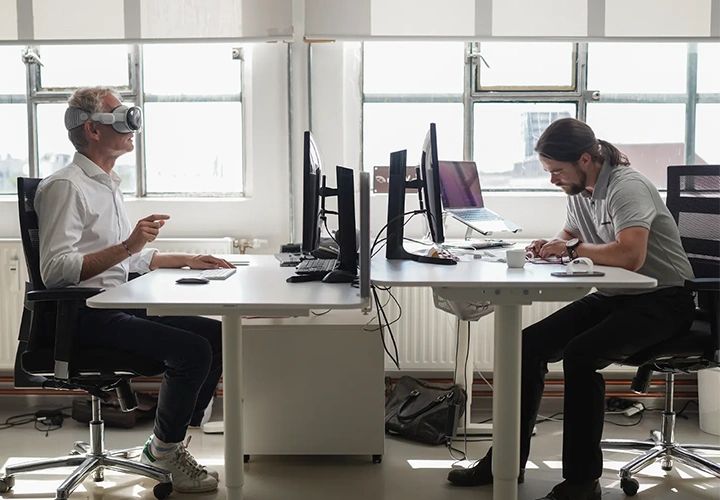
No, virtual reality (VR) will not replace jobs, but it will change many work processes. In fields with a shortage of skilled workers, VR can even take pressure off existing staff.
VR is a transformative technology that is making its way into many industries. It has the potential to improve workflows, make existing tasks more efficient and automate manual tasks, for example through virtual prototypes in manufacturing or training simulations. That doesn’t mean jobs will disappear entirely, though. Many professions will evolve and require new skills based on the use of VR.
In industries such as medicine, architecture and education, VR is already being used as a tool to complement and improve work, not to replace it.
Virtual reality can also provide valuable support in fields affected by a shortage of skilled workers and take pressure off existing staff. Here are two examples:
1. Nursing and medical training
In nursing and medicine, where the shortage of skilled workers is especially severe, VR can help train staff more effectively. Nurses and physicians can practice complex situations such as emergencies or difficult surgeries in a safe virtual environment. Surgeons, for example, practice operations in VR before performing them on real patients. In a Yale University study, VR-trained surgeons worked 29 percent faster in the operating room and made six times fewer errors (Seymour et al. 2002). This can save time and ease the burden on existing staff. It makes realistic training possible without disrupting ongoing patient care. See also our VRpedia article: How does VR improve my training and onboarding?
2. Industrial maintenance and repairs
In industry, especially in the maintenance of machinery and equipment, VR is increasingly being used to make up for the shortage of qualified technicians. Employees can work through realistic maintenance scenarios in VR without having to be on site. This lets them learn faster and more efficiently while taking pressure off experienced staff. VR also enables remote support, in which experts can give repair or maintenance instructions remotely in real time.
Conclusion
VR offers practical ways to take pressure off skilled workers in fields with heavy workloads, while also giving them the opportunity to train more efficiently. However, the technology is not expected to replace professions or jobs.