
How does VR improve my training and onboarding?
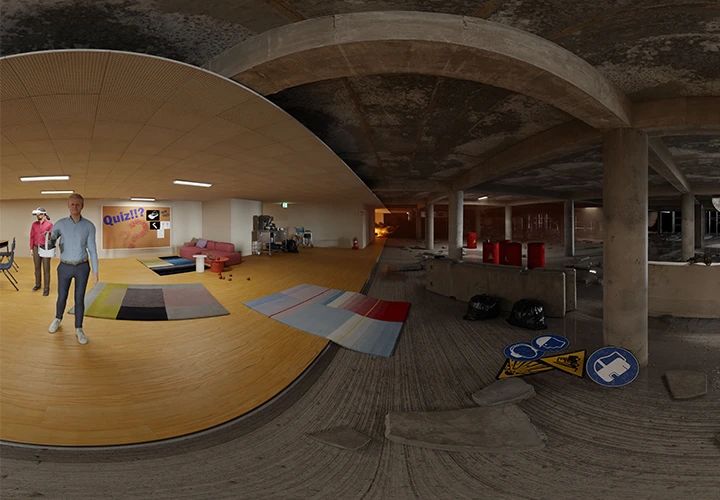
Virtual reality (VR) improves training and onboarding because new employees can practice even complex or dangerous situations without risk, as often as they like and regardless of location or trainer. This saves time and money.
VR offers practical, immersive experiences that are hard to achieve with traditional methods. Here are some of the benefits:
1. Realistic simulations
VR makes it possible to simulate complex scenarios or hazardous work environments in a safe virtual world. New employees can experience realistic situations and learn without taking any risks. This is especially useful in fields such as manufacturing, medicine or aviation, where mistakes can have serious consequences.
2. Efficient, interactive learning
Unlike conventional training, VR offers a hands-on, interactive experience. Employees can practice processes directly in the virtual environment, which encourages learning by doing. A meta-analysis of 35 studies shows that people who learn with a VR headset perform slightly better on average than with conventional methods, and the effect lasts (Wu et al. 2020). VR is strongest for practicing manual tasks and procedures. In a PwC study, employees learned up to four times faster in VR than in the classroom.
3. Time and cost savings
VR training reduces the need for physical training facilities and materials. New employees can repeat training sessions without requiring additional staff. This saves not only time but also money, since there is no need for travel or materials.
4. Scalability and flexibility
VR training can take place anytime, anywhere, which gives companies more flexibility. Onboarding programs can be customized and repeated without the employee depending on an in-person trainer. This makes training both scalable and more efficient.
Conclusion
By using VR for training and onboarding, companies benefit from realistic, safe and cost-effective learning methods. VR creates an immersive learning environment that can significantly increase employee engagement and performance.