
What can VR do that other media can’t?
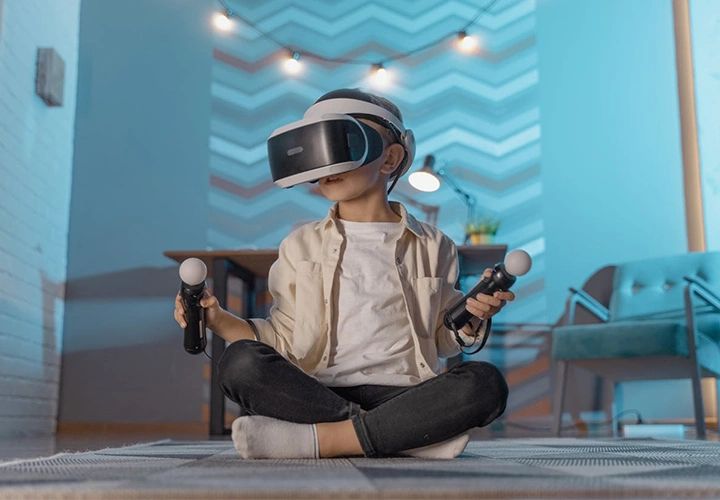
Virtual reality (VR) stands out from other media because of its unique immersion. VR places users in fully interactive 3D environments where they are in the middle of a simulation or experience instead of just watching it passively. It also offers a real sense of space, the ability to focus on individual voices and natural communication in a shared space.
1. Creating real immersion
VR users feel as if they are actually part of the digital world. That is a far more intense experience than sitting in front of a traditional screen. Immersion is best described with an example:
In a scientific experiment, heart rate and skin moisture were measured while participants watched a simulation of walking along a path. The path leads up a mountain. When the participants watched this simulation on a monitor, the readings did not change. When they experienced the same simulation in a VR headset, their heart rate and perspiration increased because the body was preparing for the effort. We see the same in our projects: people in a VR headset bend their knees, hold on to something or breathe faster when the virtual path goes uphill or up high.
The experiment shows that a VR headset can influence the autonomic nervous system, meaning bodily functions such as heartbeat or hormone release that we cannot control consciously. This becomes especially clear with phobias: fear of heights, claustrophobia, social anxiety or fear of spiders, for example, can be addressed in a VR simulation and trigger intense physical reactions. In the treatment of anxiety disorders, exposure in VR works about as well as exposure in real life, according to a meta-analysis of 30 randomized studies (Carl et al. 2019). These are extreme examples, but they show the effect virtual reality can have. In the same way, VR can also engage the reward system and trigger positive feelings (see our article Can VR be addictive?).
No other medium can create as much immersion as VR (and related technologies such as AR and MR).
2. Creating a sense of space and presence
While traditional media such as videos are two-dimensional, VR offers a real sense of space, or a sense of presence. A 3D movie (in a theater, for example) can also convey an impression of space. But in a 3D movie, you still perceive things as a passive viewer. In a VR simulation, objects give the impression of having mass and being able to affect you. For example, you will instinctively dodge objects coming toward you.
You can look at objects from every angle, walk around them and manipulate them. This lets users move freely in a space and interact with their surroundings. It makes the experience more realistic and tangible than a simulation or film on a monitor ever could.
3. Enabling focus on details (the cocktail party effect)
Much like the real world, VR lets you focus on specific sensory impressions. A good example is the so-called cocktail party effect: in a noisy environment (such as a party or a trade show), you can concentrate on a single voice and follow it easily. The human brain is able to focus on a single sound source and ignore all background noise. To do this, the brain relies on the acoustic mechanisms of our outer ear, which is why the cocktail party effect doesn’t work for people with hearing aids. In video conferences, too, it is impossible to focus on one person as soon as two people talk at the same time. Here is another example: try recording something the person across from you says in a bar. While you can understand them well in person, their words will get lost in the background noise of the phone recording.
A VR simulation can simulate the mechanisms of the human outer ear and make the cocktail party effect usable. This allows several conversations to take place at the same time in the same virtual room.
4. Enabling natural communication in a shared space
In VR, several people can speak at once without their words becoming unintelligible, as often happens in conventional video conferences. In addition to the cocktail party effect, part of the group can move to another area of the virtual room, have a private conversation and still stay in visual contact with the others.
Conclusion
There are many more mechanisms that only immersive media can offer. But these examples already show the enormous potential of virtual reality. These qualities make VR a powerful tool for training, meetings and presentations where realistic experiences are essential.