
Virtual reality, mixed reality, augmented reality: what is the difference?
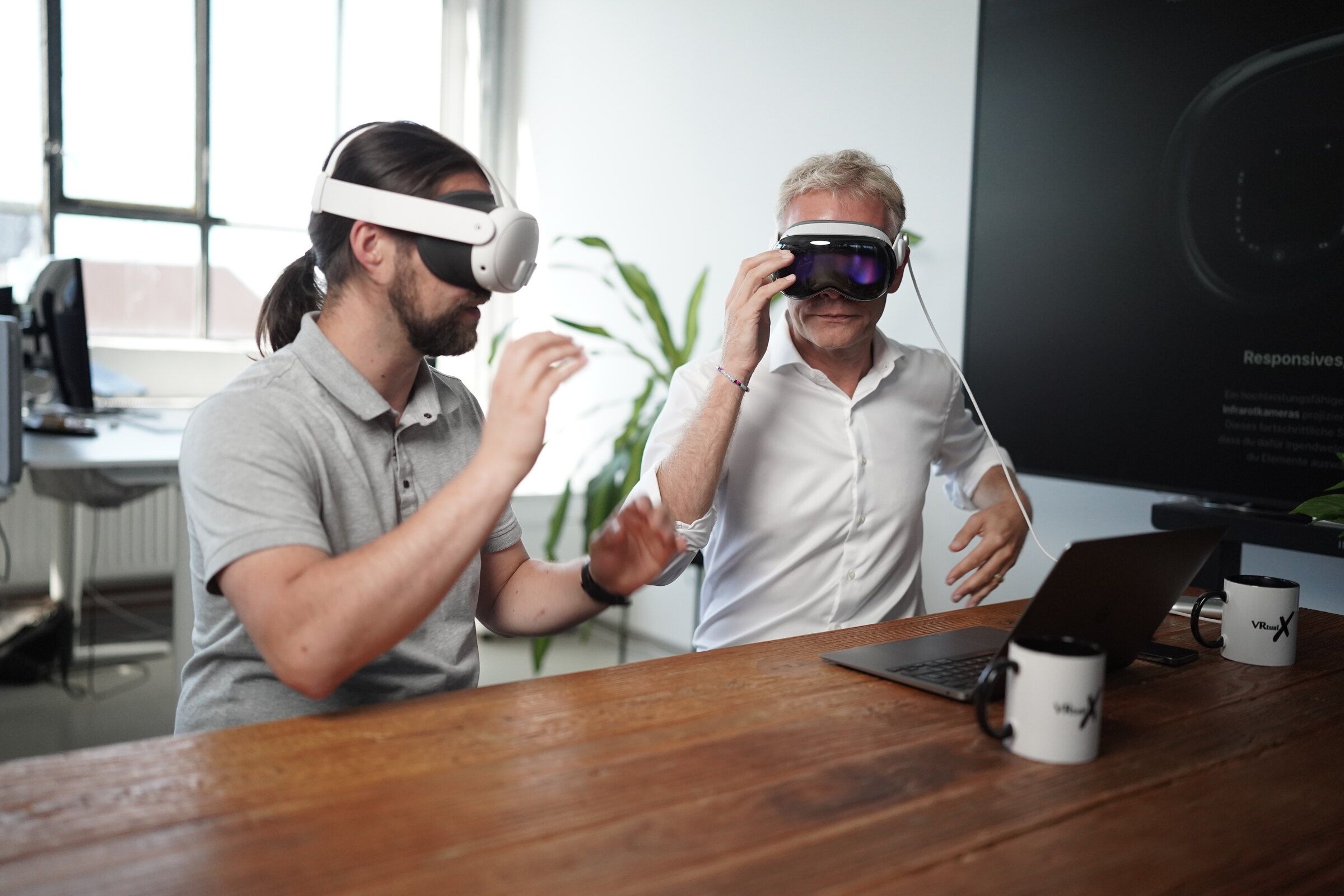
Virtual reality completely replaces your surroundings with a digital world. Augmented reality keeps your real surroundings visible and overlays digital content. Mixed reality anchors this content firmly in the room. XR is the umbrella term for all three.
The terms are often mixed up, even by manufacturers. For a business project, it ultimately comes down to one simple question: should the real surroundings be visible or not?
The terms at a glance
| Term | What you see | Example |
|---|---|---|
| Virtual reality (VR) | only the digital world | You stand in a virtual factory hall and operate a machine |
| Augmented reality (AR) | your real surroundings with overlaid content | A note appears in your field of view |
| Mixed reality (MR) | your real surroundings with content that stays fixed in the room | The machine stands true to scale in your factory hall |
| Extended reality (XR) | umbrella term | all three |
Virtual reality: a world of its own
The VR headset blocks out your surroundings. You only see and hear the simulation. This is the strongest form of immersion and the right choice when the location is unavailable, too dangerous or not yet built.
Typical uses are training and safety instructions, virtual showrooms and 360° videos.
Augmented reality: your surroundings stay
In augmented reality, you still see your room, your colleagues and your machine. Digital content is added. That can be a small note in your field of view or an entire product at full size.
Augmented reality is available on tablets, on smartphones and on glasses.
Mixed reality: content that stays in the room
Mixed reality is the more advanced form of augmented reality. The headset maps the room and anchors the content in it. A virtual component lies on the real table and stays there even when you walk around the table. It can disappear behind a real pillar.
Most current headsets can do both mixed reality and virtual reality. They film the surroundings with cameras and show them on the display. This is called passthrough.
Which headset can do what?
| Device | VR | Mixed reality | Form factor |
|---|---|---|---|
| Meta Quest 3 and 3S | yes | yes, color passthrough | headset |
| Pico 4 Ultra Enterprise | yes | yes | headset |
| Apple Vision Pro | yes | yes, very high image quality | headset |
| Samsung Galaxy XR | yes | yes | headset |
| XREAL One and One Pro | no | limited, mainly a virtual screen | glasses |
| XREAL Aura | no | yes, with hand tracking | glasses with a compute unit on a cable |
| Meta Ray-Ban Display | no | no, small display for notifications | glasses |
As of September 2026. The Samsung Galaxy XR is not yet available in Germany, and the XREAL Aura has been announced. Prices are listed in the article How much does a VR headset cost?
What fits which use case?
| Task | Recommendation |
|---|---|
| Practicing an emergency or a dangerous process | Virtual reality |
| Showing a machine that doesn’t fit on the trade show booth | Virtual reality or mixed reality |
| Showing a product in the customer’s factory hall | Mixed reality |
| Guiding manual tasks on the real equipment | Mixed reality |
| Showing a place nobody is allowed to enter | 360° video in virtual reality |
| Reaching many users without a headset | Augmented reality on tablets and smartphones |
Conclusion
The lines between the terms are blurring because the devices can do more and more. For your project, you don’t need to keep the terms apart. What matters is what your users should see and do. That determines whether virtual reality or augmented reality is the better fit, or both in one application.