
Buy off-the-shelf VR training or have it custom-developed?
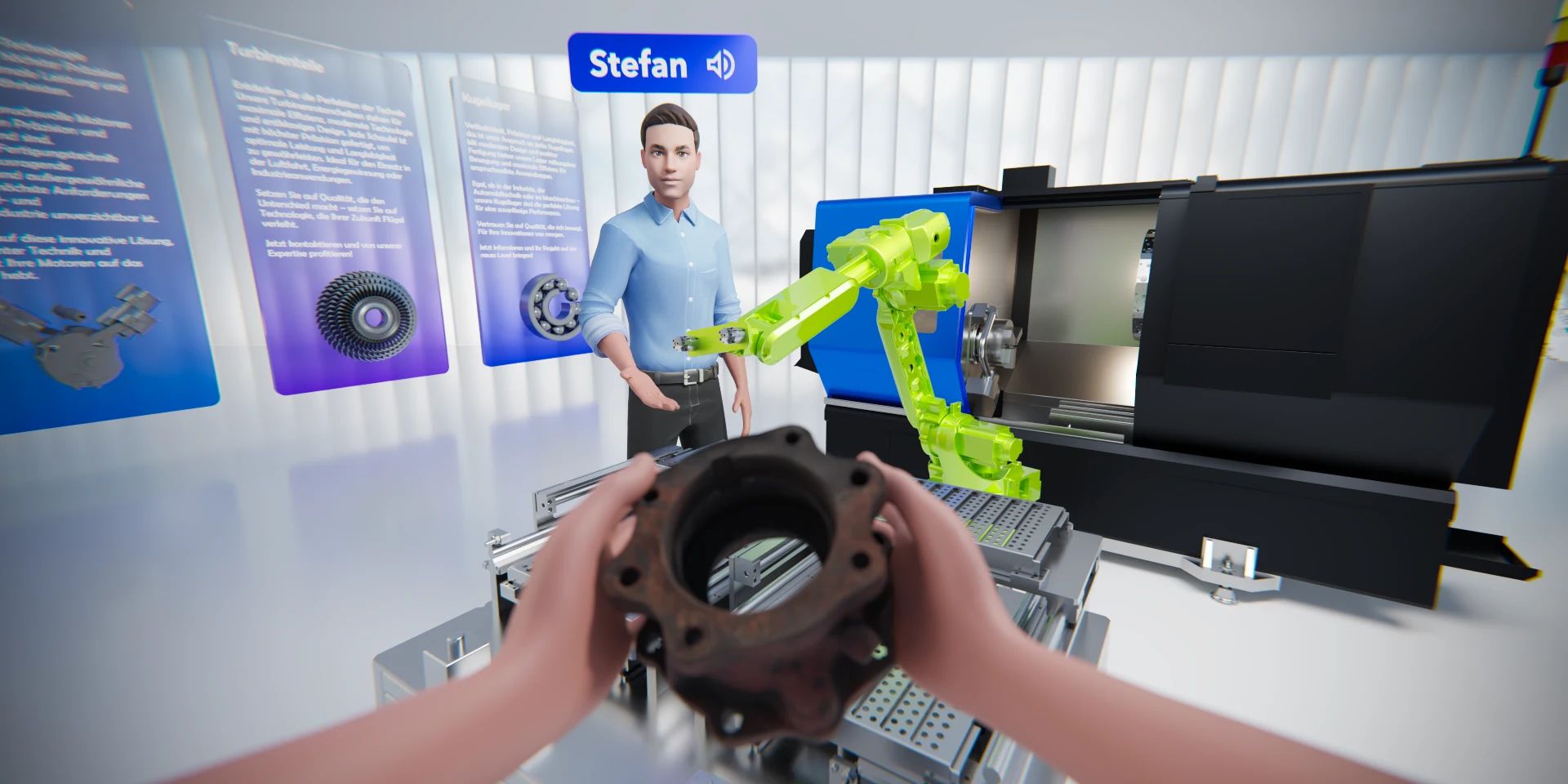
Off-the-shelf VR training works well for standard cases such as fire extinguisher practice. For anything that involves your equipment and your processes, it is usually too rigid. Modular systems seem more flexible but often become expensive later on. That is why we chose a third route: our own app base, from which custom applications can be created in a short time.
If you want to introduce training with a VR headset, you have three options. We know all three from conversations with clients who had tried something else before.
The three routes compared
| Off-the-shelf training | Modular system | Custom, built on our app base | |
|---|---|---|---|
| Content | predefined | put together yourself from predefined parts | developed for your equipment and processes |
| Start | immediately | after a learning period | after 6 to 12 weeks |
| Adapting it to your company | hardly possible | limited, anything beyond that as an additional order | from the start |
| Cost | predictable, often as an ongoing license | low at first, rises with each additional order | one-time, depending on scope |
| Typical problem | doesn’t fit your operations | effort is underestimated | needs a concept before starting |
Off-the-shelf training: good for the standard case
You can buy or rent off-the-shelf training simulations. For classic standard scenarios, they are a good choice. The best-known example is fire extinguisher practice: the process is the same everywhere, and nobody needs to see their own facility in it.
Everything else is harder. An off-the-shelf simulation shows a machine, but not yours. It follows a process, but not yours. We then see one of two outcomes: either the application is used only to a limited extent, or it is discontinued after a short time.
Modular systems: more flexible on paper
Modular systems promise that you can put together your own training. That sounds like the ideal solution. In practice, it turns out that the companies that buy these systems usually can’t configure them as easily as they expected.
The result: whatever the modular system can’t do is commissioned as custom work. Costs rise after the fact, and the original calculation no longer adds up.
Our route: an app base with many individual elements
We didn’t take either of these routes. Instead, we developed an app base made up of many individual elements. On top of that comes our asset library, which we have built up over ten years: a large collection of objects and functions that lets us deliver any project.
The result is a highly customized application at an attractive price and in a short time.
The prefab house comparison
A prefab house goes up on the building site in no time and is still highly customized. The walls come from the factory, but the owner decides on the floor plan, fittings and appearance.
That is how we work, too. Rooms, controls, avatars, quizzes and evaluations are prepared. We develop your equipment, your steps and your error scenarios for you.
Why this matters especially in training
For training and safety instructions, this difference is an enormous advantage over all off-the-shelf and system solutions:
- Recognition: Employees practice on their own equipment, not on something similar. What they learn in the headset, they find again at their workplace.
- Your own rules: Operating instructions, sequences and error scenarios differ from company to company.
- Room to grow: The application can be expanded when new equipment or processes are added.
- Multiple uses: The same application serves training, sales and trade shows.
How long it takes
| Project type | Duration |
|---|---|
| VR built from prepared modules | 6 to 12 weeks |
| Interactive VR simulation | 2 to 4 months |
| Complex simulation | from 3 months |
Large projects start small. Interactive and complex simulations almost always start with a prototype. After that, the application grows step by step, over months or years.
What each type of project costs is covered in the article How much does VR development cost?
When an off-the-shelf solution is still the better choice
If your need is a genuine standard case, such as fire safety or first aid, and your own environment doesn’t matter, go with the off-the-shelf solution. It is available immediately, and you quickly find out how your employees get on with the headset. We describe which processes are suitable for VR in a separate article.
Conclusion
Off-the-shelf training is too rigid as soon as your own operations are involved. Modular systems rarely deliver what they promise. An app base with a large library combines the best of both worlds: you get an application that fits you, in a time frame and at a price that are otherwise only possible with off-the-shelf solutions.